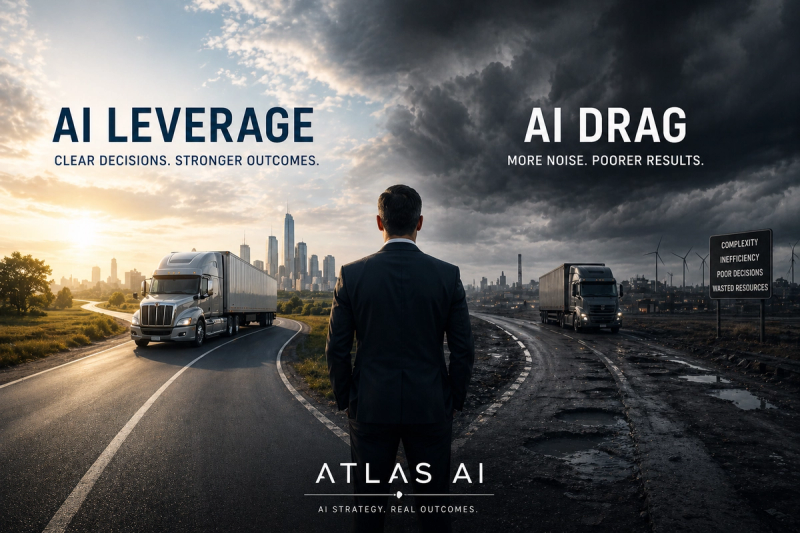
Decision-level AI vs productivity theater in logistics
Key Insights
In logistics, AI creates value only when it improves decision-making, not when it simply automates tasks.
Automating tasks increases speed and output. Decision-level AI improves judgment at critical moments such as hiring, pricing, dispatching, safety, and forecasting. Logistics companies that focus only on automation often experience productivity theater, while those that use AI to guide decisions achieve stronger margins, retention, and long-term resilience.
Most logistics companies believe they are “using AI” because their teams are moving faster.
More emails sent. More dashboards updated. More processes automated.
But speed is not the same as progress. And automation is not the same as better decisions.
The real difference between companies that gain value from AI and those stuck spinning their wheels comes down to one thing: whether AI is being used to automate tasks or improve decisions.
The Industry Shift: From Efficiency to Judgment
For years, digital transformation in logistics focused on efficiency.
Reduce manual work. Standardize workflows. Improve visibility.
AI accelerated that mindset. Suddenly, almost every task could be automated.
Job postings. CRM updates. Load status notifications. Reports. Forecasts. Content.
But something important got lost along the way.
AI is no longer just an efficiency tool. It is becoming a decision system.
The companies pulling ahead are not asking, “What can we automate next?”
They are asking, “Where are our decisions breaking down?”
In logistics, this shift matters more than in most industries.
Margins are thin. Timing is critical. Labor is unpredictable. Small decisions compound quickly.
Automation helps you move faster inside the same assumptions.
Decision-level AI helps you challenge those assumptions before they cost you.
That distinction sits at the heart of AI strategy vs automation, and it is where most AI initiatives quietly fail.
Why This Matters for Logistics Leaders
Many AI initiatives fail not because the technology is weak, but because the strategy is shallow.
According to a global survey by PwC, while a majority of executives report AI adoption, far fewer see measurable impact on decision quality or financial performance. The gap is not access to tools. It is clarity on how AI informs judgment at critical moments.
When logistics companies focus on task automation without improving decisions, they often experience:
- Faster execution of poor priorities
- More data with less clarity
- More reporting with less foresight
- More activity without better outcomes
AI should reduce uncertainty at decision points, not just increase output.
This is why Atlas AI focuses on decision-first systems across its AI strategy and consulting services for logistics companies. Execution only matters if the direction is sound.
Automating Tasks vs Improving Decisions: The Real Difference
What is the difference between automating tasks and improving decisions with AI?
Automating tasks uses AI to execute predefined actions faster, such as sending messages or updating systems. Improving decisions uses AI to analyze data, identify patterns, and guide leaders toward better choices before actions are taken.
That difference sounds subtle. In practice, it is massive.
Task automation answers, “How fast can we do this?”
Decision intelligence answers, “Should we do this at all?”
In logistics, those questions carry very different consequences.
How AI Strategy vs Automation Shows Up in Daily Logistics Decisions
One of the biggest misconceptions in logistics is that AI strategy lives at the enterprise level while automation lives at the operational level.
In reality, the divide shows up in everyday decisions leaders make dozens of times a week.
Consider dispatching.
Task automation optimizes the mechanics. Loads assigned faster. Notifications sent automatically. Exceptions flagged.
Decision-level AI evaluates the tradeoffs.
Which route increases driver fatigue?
Which assignment increases churn risk?
Which customer is likely to escalate based on past behavior?
Automation answers how.
Decision intelligence answers whether and why.
Now look at pricing.
Automated pricing tools adjust rates based on predefined rules. That improves speed but not judgment.
Decision-level AI evaluates margin erosion, customer lifetime value, lane volatility, and competitive pressure simultaneously. It supports executive decision-making in real time, not just operational execution.
This is why AI strategy vs automation is not an abstract debate. It determines whether leaders are steering the business or simply accelerating existing habits.
Real-World Applications in Logistics
1. Recruiting Speed vs Hiring Quality
A carrier automates job postings across multiple platforms. Applications increase. Turnover does not improve.
Why?
Because the real decision problem was not how quickly jobs were posted.
It was which drivers were most likely to stay.
Decision-level AI evaluates historical retention data, route types, pay structures, and onboarding timelines to prioritize candidates based on likelihood of long-term success, not just availability.
This is decision-level AI in action.
2. Content Automation vs Revenue Influence
A logistics services firm uses AI to generate daily LinkedIn posts. Engagement increases. Leads do not.
The task was automated. The decision was not.
Decision intelligence connects content topics to buyer intent, sales conversations, and closed-won deals. It helps leaders decide which messages actually influence revenue, not just which ones fill a calendar.
Atlas AI regularly explores this distinction in its insights on AI strategy and decision intelligence.
3. CRM Automation vs Sales Judgment
Automated follow-ups trigger on schedule. Prospects still go silent.
Because timing is a decision, not a rule.
Decision intelligence analyzes response patterns, deal velocity, and buyer behavior to guide when to engage, when to wait, and when to escalate.
This is AI for executive decision-making, not just workflow automation.
4. Safety Reporting vs Risk Prevention
AI generates clean weekly safety reports. Incidents continue.
Reporting looks backward. Decisions look forward.
Decision intelligence identifies leading indicators of risk, such as route fatigue patterns or behavioral trends, before incidents occur, giving leaders the chance to intervene early.
5. Forecasting Revenue vs Steering Outcomes
Revenue forecasts update automatically. Leadership still reacts too late.
Decision-level AI focuses on scenario modeling and probability shifts, helping executives decide where to intervene now, not just what happened last month.
ROI and Data Insights
Research consistently shows that AI delivers more value when it supports judgment rather than just execution.
MIT Sloan Management Review found that organizations using AI to augment managerial and strategic decision-making outperform those using AI primarily for operational efficiency.
Gartner echoes this, noting that the highest-performing AI adopters embed AI into decision workflows rather than isolating it within task automation.
The takeaway is straightforward.
- Task automation produces linear gains
- Decision intelligence produces compounding returns
Time savings plateau. Better decisions scale.
Key Takeaways for AI Strategy in Logistics
- Automation improves efficiency, not judgment.
- Decision-level AI improves outcomes, not just output.
- Productivity theater creates activity without advantage.
- Logistics leaders gain leverage when AI informs hiring, pricing, routing, safety, and forecasting decisions.
- AI strategy succeeds when it supports executive decision-making, not when it replaces it.
The Problem with Productivity Theater
Many organizations mistake visible automation for progress.
Dashboards multiply. Tools stack up. Activity increases.
But decision quality stays the same.
This is AI productivity theater.
It looks modern. It feels busy. It rarely changes outcomes.
Productivity theater is seductive because it is easy to measure. Decisions are harder.
Decision-level AI forces leaders to confront uncomfortable questions about assumptions, tradeoffs, and accountability.
That discomfort is where growth begins.
Why Decision-Level AI Is a Leadership Skill, Not a Technology Upgrade
One reason productivity theater persists is because automation feels safe.
It improves visible output without forcing leaders to change how they think.
Decision-level AI is different. It surfaces uncomfortable truths.
It shows where assumptions are outdated.
It highlights tradeoffs leaders would rather avoid.
It exposes where intuition no longer matches reality.
That is why decision intelligence adoption is less about technology and more about leadership maturity.
According to research from the Stanford Institute for Human-Centered Artificial Intelligence, organizations that treat AI as a decision-support system rather than a replacement for human judgment achieve better alignment, trust, and long-term impact.
In logistics, this matters because leadership decisions ripple quickly across safety, retention, cost, and service quality.
Decision-level AI does not remove accountability. It sharpens it.
Leaders still decide.
AI simply ensures those decisions are informed by reality, not habit.
This is the core shift Atlas AI helps logistics companies navigate through its decision-first consulting approach. Strategy comes before automation, not after.
The Atlas AI Decision-First Framework
At Atlas AI, AI strategy starts with decisions, not software.
Step 1: Identify High-Impact Decisions
We map the decisions that most affect revenue, retention, risk, and growth.
Not tasks. Decisions.
Step 2: Audit Decision Signals
We evaluate what data informs those decisions today and what signals are missing or ignored.
Most logistics companies have data. Few have clarity.
Step 3: Design Decision Intelligence
We design AI systems that surface probabilities, patterns, and tradeoffs at the moment decisions are made.
This is AI decision intelligence, not automation theater.
Step 4: Embed Insights into Real Workflows
Insights must live where decisions happen, not in separate dashboards that go unchecked.
Step 5: Train Leaders to Interpret Outputs
Decision-level AI only works when leaders know how to question, validate, and act on insights.
This is leadership work, not tool deployment.
Challenges and Common Fears
“We are not ready for advanced AI.”
Most companies already make high-stakes decisions with incomplete data and intuition. Decision intelligence improves judgment incrementally. It does not require perfection.
“This feels too complex.”
Automation feels easy because it mirrors existing workflows. Decision intelligence feels harder because it challenges how leaders think.
Complexity is not the risk. Blind speed is.
“What if we rely on AI too much?”
Decision-level AI does not replace human judgment. It sharpens it.
Insight without accountability is useless. Accountability without insight is dangerous.
What This Means for Logistics Leaders
AI is not failing logistics companies because it is immature or overhyped. It is failing because it is being aimed at the wrong problem.
When AI is used to automate tasks, it improves speed but rarely changes outcomes. When AI is used to improve decisions, it reshapes how leaders allocate resources, manage risk, and drive long-term performance.
For logistics leaders, the shift is not about adopting more tools. It is about identifying the decisions that matter most and using AI to bring clarity to those moments.
Companies that make this shift stop chasing productivity metrics and start building judgment at scale. Over time, that difference compounds into better margins, stronger retention, and more resilient operations.
Frequently Asked Questions About Decision-Level AI in Logistics
What is decision-level AI in logistics?
Decision-level AI refers to systems that analyze operational, financial, and behavioral data to help leaders make better choices before actions are taken, rather than simply automating existing workflows.
How is decision-level AI different from automation?
Automation focuses on executing tasks faster. Decision-level AI focuses on improving judgment by surfacing tradeoffs, probabilities, and risks at critical decision points.
Why do many AI initiatives fail in logistics?
Many initiatives fail because they prioritize visible automation over decision quality. This leads to productivity theater rather than measurable business impact.
Where should logistics companies start with AI strategy?
Logistics companies should start by identifying their most expensive or risky decisions and designing AI systems to support those moments first.
What to Do Next
If your AI efforts feel active but not impactful, it may be time to rethink the strategy behind them.
If you want to explore how decision-level AI can improve judgment across recruiting, operations, marketing, and leadership, schedule a strategy conversation with Atlas AI.
👉 https://calendly.com/atlasaimarketing-info/30min