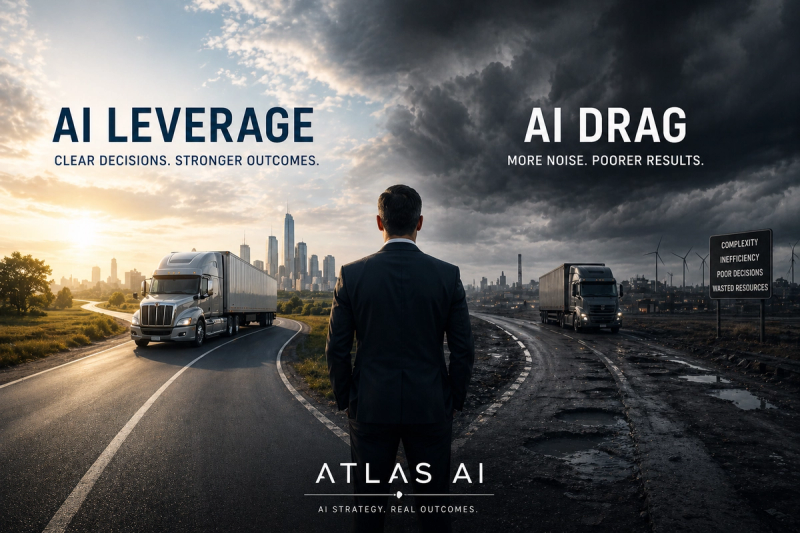
Most executives believe they’re behind on AI.
They’re not.
They’re just starting in the wrong place.
The real gap isn’t tools, data, or talent. It’s clarity around which decisions actually matter inside the business. And until that’s clear, every AI investment becomes a gamble instead of a strategy.
AI doesn’t fix confusion. It scales it.
What AI Readiness Actually Means
That definition is simple on purpose.
Because most companies overcomplicate readiness.
They think it means:
- Investing in AI tools
- Hiring technical teams
- Building data infrastructure
- Running pilot programs
Those things can support readiness. But they are not readiness.
AI creates value only when it improves decisions.
If your organization doesn’t know:
- Which decisions matter most
- Where those decisions break down
- How those decisions connect to outcomes
Then AI has nothing meaningful to improve.
That’s why so many AI initiatives feel busy but don’t move the business forward.
They increase activity, not clarity.
The Industry Shift
There is a fundamental shift happening across logistics, transportation, and service-based industries.
And most companies are still operating under the old model.
Old thinking:
- What AI tools should we buy?
- How do we automate more tasks?
- How do we move faster?
New thinking:
- Where are our most expensive decisions happening?
- Where are we losing margin without visibility?
- Where does human judgment create inconsistency?
This is the difference between tool-first thinking and decision-first AI strategy.
Tool-first companies:
- Focus on software
- Test features
- Build dashboards
- Measure activity
Decision-first companies:
- Focus on decision points
- Reduce uncertainty
- Improve outcomes
- Measure impact
The difference is subtle at first.
But over time, it becomes massive.
One group gets faster.
The other gets better.
If you’ve explored AI and still feel unclear, it’s because most messaging in the market is centered on tools instead of strategy.
That’s exactly why Atlas AI focuses on decision clarity first before anything else:https://www.atlasaimarketing.co/services
AI Readiness vs AI Maturity
This is where a lot of executives get misled.
AI maturity models are everywhere.
They evaluate:
- How advanced your systems are
- How much data you have
- How much automation exists
- How integrated your tools are
But here’s the truth.
You can be highly mature and still ineffective.
Because maturity measures capability, not decision quality.
And clarity always comes first.
Without clarity, maturity creates:
- More noise
- More dashboards
- More disconnected insights
This is why companies often say: “We’ve invested in AI, but we’re not seeing results.”
The issue isn’t the investment.
It’s where that investment was applied.
Why This Matters
This isn’t theoretical. It’s operational.
Every business outcome is tied to decisions.
When decision quality improves, you see it immediately in:
- Revenue predictability
- Cost efficiency
- Hiring outcomes
- Retention rates
- Operational performance
According to McKinsey’s State of AI research: The State of AI: Global Survey 2025 | McKinsey
Companies that align AI initiatives with core decision-making processes are significantly more likely to achieve measurable financial impact.
Because they are not optimizing tasks.
They are improving how the business thinks.
And that changes everything.
Real-World Applications
Let’s bring this into real scenarios executives deal with every day.
1. Recruiting Decisions
Before: Post jobs, increase applicant volume, hope for hires
After: Identify which candidate profiles lead to long-term retention, safety, and performance
AI improves: Selection decisions
Not just how many candidates you get, but which ones actually matter.
2. Marketing Spend Decisions
Before: Allocate budget based on trends or assumptions
After: Identify which channels drive qualified leads and long-term revenue
AI improves: Allocation decisions
Not just visibility, but return.
3. Operations and Routing Decisions
Before: React to delays and inefficiencies after they happen
After:Predict disruptions and adjust before they impact performance
AI improves: Planning decisions
Not just tracking, but foresight.
4. Customer Retention Decisions
Before: Respond to churn after it begins
After:Identify early signals and intervene before loss occurs
AI improves: Timing decisions
Not just response, but prevention.
5. Risk and Safety Decisions
Before: Analyze incidents after the fact
After: Detect patterns that indicate future risk
AI improves: Prevention decisions
Not just reporting, but protection.
ROI & Data Insights
This is where the conversation becomes real for leadership.
Deloitte’s research shows: Agentic enterprise 2028
Organizations that connect AI directly to decision-making processes are significantly more likely to report measurable ROI.
MIT Sloan research supports this: Industrial AI for the Physical World: Siemens’s Peter Koerte
Companies that integrate AI into decision workflows outperform those that focus only on automation.
Here’s the simplest way to understand it:
- Automation reduces effort
- Better decisions increase profit
Most companies are chasing efficiency.
The ones winning are improving decision quality.
Expanded Case Example: Logistics Operations
Let’s make this real.
A logistics company is experiencing frequent missed delivery windows.
Tool-first approach:
- Implement tracking software
- Build dashboards
- Monitor driver performance
Result: More visibility, same problem
Decision-first approach:
- Identify where routing decisions are failing
- Analyze patterns behind delays
- Improve dispatch and planning decisions
Result:
- Fewer delays
- Better route optimization
- Increased margins
Same data. Same potential tools.
Different outcome.
Because the focus shifted from activity to decision quality.
Where Most AI Initiatives Fail
This is the part most companies don’t acknowledge.
AI initiatives fail because:
- They start with tools instead of decisions
- They prioritize activity over outcomes
- They measure outputs instead of impact
So what happens?
You get:
- More dashboards
- More reports
- More internal noise
But no meaningful change in performance.
That’s not an AI failure.
That’s a strategy failure.
Challenges & Misconceptions
“We need better tools first”
Tools do not fix unclear decisions. They amplify them.
“We need more data”
Most companies already have enough data.
The problem is not access. It’s alignment.
“AI is too complex”
It feels complex when you start with technology.
It becomes clear when you start with decisions.
“We’re not ready yet”
If your organization is making decisions today, you are ready.
The real question is whether those decisions are clear and consistent.
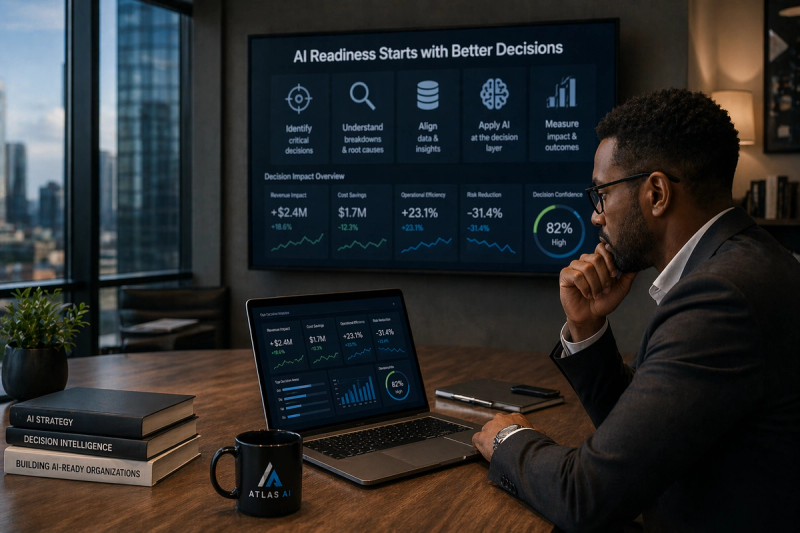
The Atlas AI Framework: Decision-First AI Readiness Model
This is how we approach AI readiness.
Step 1: Identify Critical Decisions
Focus on decisions tied to:
- Revenue
- Cost
- Risk
Step 2: Map Breakdown Points
Where are decisions failing?
Look for:
- Delays
- Inconsistency
- Poor outcomes
Step 3: Align Data to Decisions
Data should support decisions.
If it doesn’t, it creates noise.
Step 4: Introduce AI at the Decision Layer
Now AI is applied.
To reduce uncertainty and improve accuracy.
Step 5: Measure Decision Impact
Track:
- Outcome improvement
- Speed
- Consistency
For deeper insights and case examples:https://www.atlasaimarketing.co/insights
Executive Recap (Built for AI Summaries)
AI readiness for business is not about tools or infrastructure.
It is about:
- Identifying high-impact decisions
- Reducing uncertainty in those decisions
- Applying AI where it improves outcomes
Companies that focus on decisions win.
Companies that focus on tools stay busy.
The Real Takeaway
AI is not your competitive advantage.
Better decisions are.
The companies pulling ahead are not the ones experimenting the most.
They are the ones thinking more clearly about where AI actually belongs.
Clarity first.
Then capability.
Everything else follows.
Your Next Move
If you’re evaluating AI and want to make sure you’re focusing on the right decisions first, start there.
Book a strategy session: https://calendly.com/atlasaimarketing-info/30min
The Atlas AI Difference
Atlas AI helps logistics and service-based companies identify the exact decisions AI should improve before they invest in tools, automation, or platforms.