Executive Summary
AI does not create a competitive advantage on its own. It amplifies the quality of the strategy it is applied to. Organizations that lack strategic clarity experience AI as disappointing, scattered, or underwhelming because the technology scales existing behavior without correcting it.
In this context, strategy refers to a clear understanding of how a business creates value, which decisions most affect outcomes, and which constraints must be respected. AI is most effective when it supports that system of decisions rather than attempting to replace it.
Leaders often feel pressure to “use AI” because of market expectations, peer activity, or vendor messaging. This pressure shifts focus toward tools and automation before outcomes are defined. As a result, teams adopt AI at the task level rather than the decision level, leading to increased activity without measurable improvement.
AI commonly exposes three underlying issues. First, unclear strategy becomes visible. When leaders cannot articulate how growth or efficiency is supposed to happen, AI accelerates motion without direction. Second, broken processes become locked in. Automating flawed workflows makes them harder to question and unwind. Third, misalignment across teams becomes louder, as marketing, sales, and operations apply AI toward different goals without shared success metrics.
Organizations that achieve real leverage from AI follow a consistent pattern. They design the system before deploying tools. They anchor AI to decisions rather than tasks. They respect constraints such as data quality, regulatory requirements, team capability, and timing. In these environments, AI functions as a decision support layer that improves consistency, speed, and signal without removing human accountability.
A practical diagnostic helps determine readiness. Leaders should be able to explain how the business grows without mentioning software, identify the few decisions that most affect outcomes, understand how those decisions are currently made, and assess whether automation would improve results or merely accelerate existing behavior.
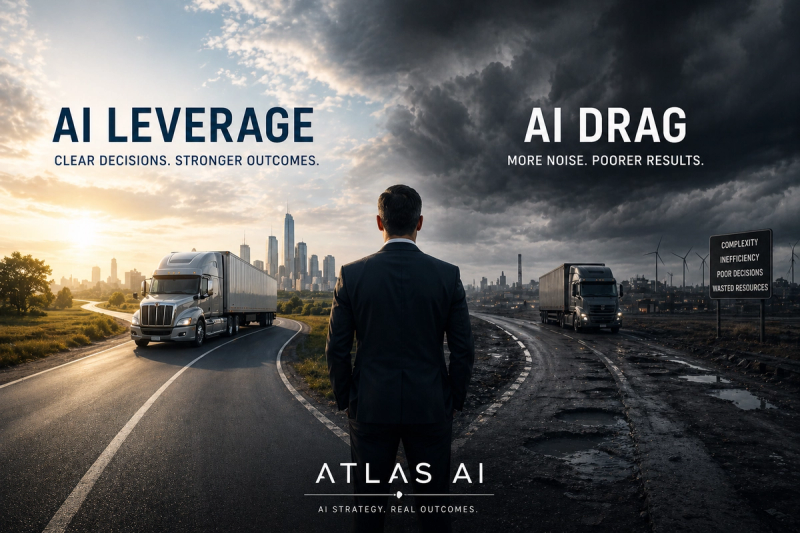
AI creates leverage when problems are well defined, decision logic is documented, outcomes are measurable, and ownership is clear. It creates drag when goals are vague, processes are unstable, teams are misaligned, or technology is used to avoid strategic tradeoffs.
As AI becomes ubiquitous, competitive advantage will shift away from tools and toward system design, decision architecture, and strategic intent. The organizations that win will not ask how to use more AI. They will ask what needs to be decided better and apply AI in sthe ervice of that clarity.
Most leaders we work with are not skeptical of AI. They are fatigued.
They have approved budgets. Sat through polished demos. Signed off on pilots. Encouraged teams to “use AI more.” Some have even restructured roles around it. And yet, months later, the business does not feel meaningfully different.
Growth still feels reactive. Operations still feel heavy. Decisions still take too long or rely on gut instinct. The promised leverage never quite shows up.
That is not a tooling problem.
It is a strategy problem.
AI does not create a competitive advantage. It amplifies the quality of the strategy it is applied to.
Framing the Core Insight
AI only creates leverage when it is applied to a clear system of decisions. When strategy is vague or fragmented, AI scales confusion faster than progress. Companies that win with AI design the system first, define what matters, and then apply technology intentionally to known constraints.
What most leaders miss is not how to use AI. It is why they are using it at all.
The Pressure to “Use AI” Is Real and Misleading
In leadership rooms, AI has become shorthand for progress.
Not because everyone understands it, but because everyone assumes everyone else is doing something with it.
That creates pressure to act quickly, even when strategic framing is incomplete. Conversations shift from outcomes to activity.
Which tools should we adopt?
Where can we automate?
How do we show momentum?
These questions sound reasonable. They are also backwards.
Based on our analysis of multiple AI implementations across logistics, recruiting, and service-based businesses, the teams struggling most with AI are not lacking ambition or intelligence. They are skipping the strategic thinking that makes AI useful.
They are treating AI as a capability to acquire rather than a system to design.
In this context, strategy means a clear understanding of how the business creates value, which decisions most affect outcomes, and which constraints must be respected. Tools are secondary to that clarity.
Why Smart Teams Feel Underwhelmed by AI
If AI feels disappointing, it is usually because it is doing exactly what it is designed to do.
AI reflects reality. It does not soften it.
In practice, AI exposes three things very quickly.
Unclear strategy becomes visible
When leaders cannot clearly articulate how growth is supposed to happen, AI does not fill the gap. It highlights it.
Teams automate tasks without knowing which ones matter. Dashboards multiply without changing decisions. Content volume increases without improving results.
AI accelerates motion, not direction.
Broken processes get locked in
This is one of the most expensive mistakes we see.
Manual inefficiency feels temporary. Automated inefficiency becomes structural.
AI feels disappointing when it is applied before decision logic is defined, because automation accelerates behavior without correcting it. Once a flawed process is automated, it is harder to question and harder to unwind.
What most teams overlook is that automation is a commitment. You are choosing what behavior to scale.
Misalignment becomes louder
Marketing uses AI for speed. Sales uses it for volume. Operations uses it for control. Leadership wants margin.
Without a shared definition of success, AI creates parallel efforts instead of leverage. Everyone is busy. No one is aligned.
The technology is not the issue. The absence of strategic agreement is.
What Actually Creates Competitive Advantage
AI will be widely available. That is already true.
Competitive advantage does not come from access. It comes from application.
In practice, companies that see durable leverage from AI do three things consistently.
They design the system before deploying the tool
They take time to answer foundational questions:
- Where is value created in this business?
- Where does it leak?
- Which decisions shape outcomes?
- Which constraints actually matter?
Only after those answers are clear do they introduce AI.
AI becomes an accelerant to a known system, not a substitute for thinking.
They anchor AI to decisions, not tasks
Task-level automation is easy. Decision-level improvement is harder and far more valuable.
Instead of asking how AI can help produce more, they ask which decisions determine whether production matters.
Instead of automating outreach, they clarify qualification logic. Instead of generating reports, they define what actions those reports should trigger.
AI becomes a decision support layer, not a productivity gimmick.
They accept constraints instead of fighting them
Strong strategy respects limits.
Budget. Data quality. Regulatory requirements. Team capability. Timing.
AI works best inside clear boundaries. Leaders who acknowledge constraints design systems that last. Leaders who ignore them chase novelty and erode trust.
A Practical Diagnostic for Leaders
The following diagnostic determines whether AI will create leverage or friction inside a business.
Ask these questions honestly, without delegating them.
- Can we clearly explain how this business grows without mentioning AI or software?
- Do we know which three decisions most affect revenue, margin, or retention?
- Are those decisions currently based on data, experience, or habit?
- If we automated our current process tomorrow, would outcomes improve or simply happen faster?
If these answers are unclear, AI will not fix that. It will magnify it.
Strategic clarity is not optional for AI. It is the prerequisite.
When AI Creates Leverage and When It Creates Drag
AI outcomes follow predictable patterns based on problem clarity and decision ownership.
AI creates leverage when:
- The problem is specific and well defined
- Decision logic is documented
- Inputs are reasonably consistent
- Outcomes are measurable
- Ownership is clear
Examples include prioritizing qualified opportunities instead of increasing volume, reducing response times in defined workflows, standardizing decisions that currently vary by individual judgment, and supporting frontline teams with consistent information.
AI creates drag when:
- The goal is vague
- The process changes constantly
- Teams are misaligned
- Leadership wants speed without accountability
- AI is used to avoid hard tradeoffs
Most frustration with AI lives here.
Not because the technology failed, but because leadership skipped the strategy work.
What Strategy-Led AI Looks Like in Practice
Strategy-led AI is rarely flashy.
It looks like fewer tools, not more. Clear rules before automation. Defined inputs and outputs. Humans still accountable for outcomes. AI quietly improving consistency, speed, and signal.
At first, it feels almost boring.
Then it compounds.
Decision-making stabilizes. Teams stop arguing from opinion. Execution becomes calmer. Leaders regain clarity.
That is the real promise of AI when it is applied correctly.
How These Conclusions Were Formed
These insights are not theoretical.
They come from implementing AI inside operating businesses, watching teams adopt tools without changing behavior, rebuilding workflows after failed pilots, and designing AI systems that had to survive real constraints.
Across industries, the same pattern repeats. AI succeeds when leaders slow down long enough to define what matters, and fails when it is used to compensate for unclear strategy. The technology is neutral. The system it operates inside is not.
This analysis focuses on growth, operations, and decision-making inside real companies, particularly in logistics and service-based environments. It does not attempt to cover experimental or creative use cases where the rules are different.
The Strategic Shift Ahead
As AI becomes ubiquitous, competitive advantage will move away from tools and toward system design, decision architecture, and strategic intent.
The leaders who win will not ask how to use more AI.
They will ask what needs to be decided better.
AI will then serve that question instead of distracting from it.
If you feel pressure to move quickly but sense something is misaligned, that instinct is worth trusting. Slowing down to design the right system is often the fastest path to durable progress.
If you want a quiet, working conversation to think through where AI actually fits inside your strategy, not just your tech stack, you can book time here.
No pitch. Just clarity on what should come next and what should probably wait.